Is Kitesurfing Safe for Beginners on Koh Phangan — and What About Wing Foiling?
Is Kitesurfing Safe for Beginners on Koh Phangan — and What About Wing Foiling?
Every first-timer has a version of this question. Some ask it directly before booking. Others think it quietly while watching someone else ride from the beach. The honest answer is that both kitesurfing and wing foiling carry real physical demands, and neither is consequence-free if approached carelessly. What changes the equation significantly is where you learn, who teaches you, and whether the progression follows a structured safety system rather than improvised enthusiasm.
On those three variables, Koh Phangan sits in a genuinely favourable position — and the reasons are specific enough to be worth explaining rather than summarising as “great conditions.”
Why this lagoon changes the safety calculation
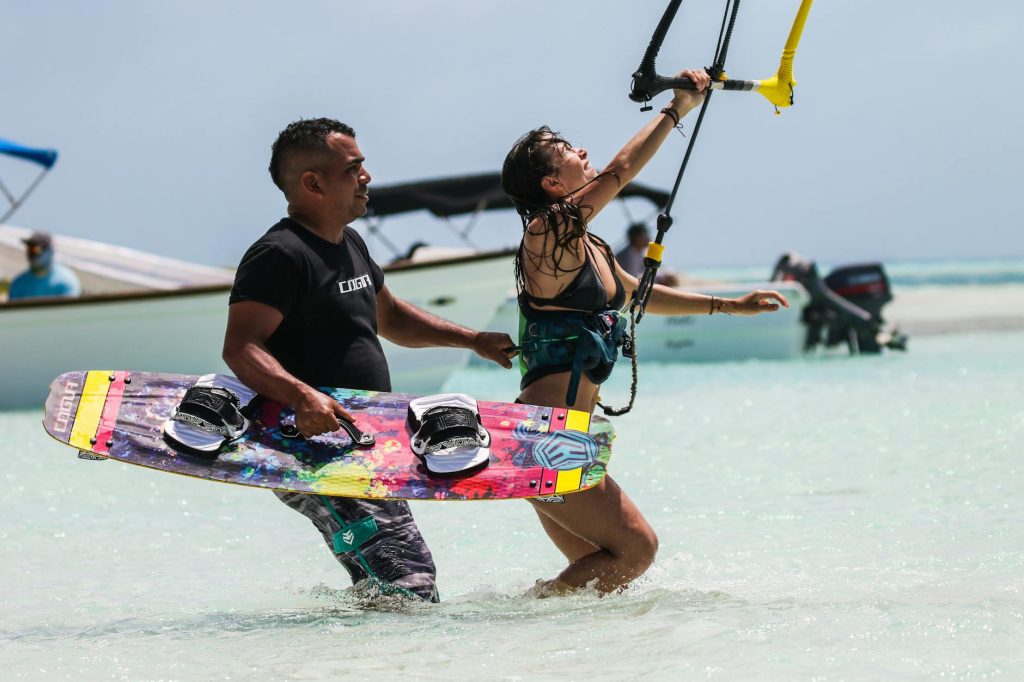
The spot where you run your kite surfing on Koh Phangan sessions is a shallow lagoon — you can stand up at almost any point during the learning phase. That single fact removes the most common source of early-stage panic in both kitesurfing and wing foiling: the feeling of being out of your depth, literally, while managing unfamiliar equipment. When a student falls, loses the kite, or simply needs a moment to reset, putting their feet on a sandy bottom changes the psychological dynamic of the session entirely. Stress drops. Learning accelerates.
The wind adds to this. The northeast monsoon that runs from November through April delivers steady, consistent pressure — typically 12 to 18 knots — without the sharp gusts and sudden lulls that characterise more exposed coastlines. For a newcomer building kite control or learning to hold an inflatable wing in position, predictable wind means the equipment behaves the same way from one attempt to the next. Muscle memory builds on a stable foundation rather than constantly adapting to changing conditions.
Wide open beach space and minimal boat traffic through the riding zone reduce collision risk to near zero during lessons. Warm Gulf of Thailand water — above 28°C through the high season — eliminates cold shock and fatigue, which means sessions run longer and students stay focused rather than physically drained.
Kitesurfing safety: what the IKO system actually means in practice
The IKO, the International Kiteboarders Organisation, sets the global standard for kite instruction. Its certification pathway is progressive by design: no student advances to the next level until the previous one is demonstrated safely and consistently. That structure exists precisely because kitesurf has a defined set of risks — lines under tension, power generated overhead, board control in moving water — and the IKO framework addresses each of them in sequence before adding the next layer of complexity.
At Kite Club on Koh Phangan, the instructors running kite sessions hold IKO Level 2 and Level 3 certification, with more than five years of teaching experience per coach. The Discovery course — 2 hours at 3,500 THB — is designed specifically for those who want to feel the sport before committing to a full learning programme. It covers the basics of kite control, safety release systems, and first water contact without pressure to progress faster than the student is ready for. All safety equipment, including harness and board leash, is provided. Nothing is improvised or left to the student to source.
One scenario that comes up regularly: a student arrives having watched online tutorials and wants to skip straight to board work. The answer is always the same — kite control first, on the beach, until it’s automatic. That patience in the early sessions is what makes the water work safe rather than chaotic.
Wing foiling safe for beginners: the IWO standard
IWO-certified instruction for wing foil on Phangan means the safety framework is set by an international governing body, not by individual school policy. The International Wingfoil Organization establishes the progression standards, equipment protocols, and instructor qualification criteria that certified centres are required to follow. At Kite Club, both Abdulla and Abdo hold IWO certification — Abdo carries IKO Level 3 alongside it, giving the wing foil programme an instructor with dual-discipline safety training.
Wing foiling has a different risk profile from kitesurfing. There are no lines between the rider and the power source — the inflatable wing sits in your hands and releases instantly if you let go. That removes the entanglement risk that requires specific management in kite sessions. The foil under the board introduces its own considerations at speed, since the mast and foil assembly are rigid and sharp-edged. The IWO progression addresses this directly: beginner sessions keep the board on the water surface until wing control and board balance are established. The foil only becomes relevant once the fundamentals are solid.
For a cautious first-timer, sequencing matters. You are not put on a foil board in 15 knots of wind on your first afternoon. The progression is measured, and each stage has a clear safety rationale behind it.
An honest comparison of risk between the two sports
Neither sport is dangerous when taught correctly at a shallow-water location with certified instruction. Both involve physical activity in open water, and both require students to follow instructor guidance rather than improvise.
Kitesurfing demands spatial awareness around lines and a respect for the power ceiling as wind increases. The IKO system manages this through progressive skill gates. Wing foiling involves a foil assembly that requires care at speed and during falls, managed through the IWO progression framework and mandatory protective gear in early sessions. Neither risk profile is beyond the reach of a careful adult with no prior board sport experience — and Phangan’s shallow lagoon, steady wind, and open water space reduce the practical risk level further than most other learning destinations in the region.
Before you book: a practical checklist
A few straightforward points that apply regardless of which sport you choose:
- Start with the entry-level option before committing to a full course. For kitesurfing, that’s the 2-hour Discovery session. For wing foiling, it’s a single 2-hour lesson. Both give you a real feel for the sport without financial overcommitment.
- Verify instructor certification before you get in the water. IKO for kitesurfing, IWO for wing foiling. Both are internationally recognised and publicly verifiable.
- Choose a shallow-water learning location. Deep open water is not where beginners should be building their first sessions.
- Bring a swimsuit, towel, and sunscreen. All equipment — kite or wing, board, harness, safety gear — is included in course prices at Kite Club.
High season on Koh Phangan runs December through April. To ask about current conditions, check instructor availability, or book a first session, contact Kite Club on WhatsApp at +66 967203910. The team will answer the safety questions too — directly, without the reassuring vagueness that doesn’t actually help anyone make a decision.